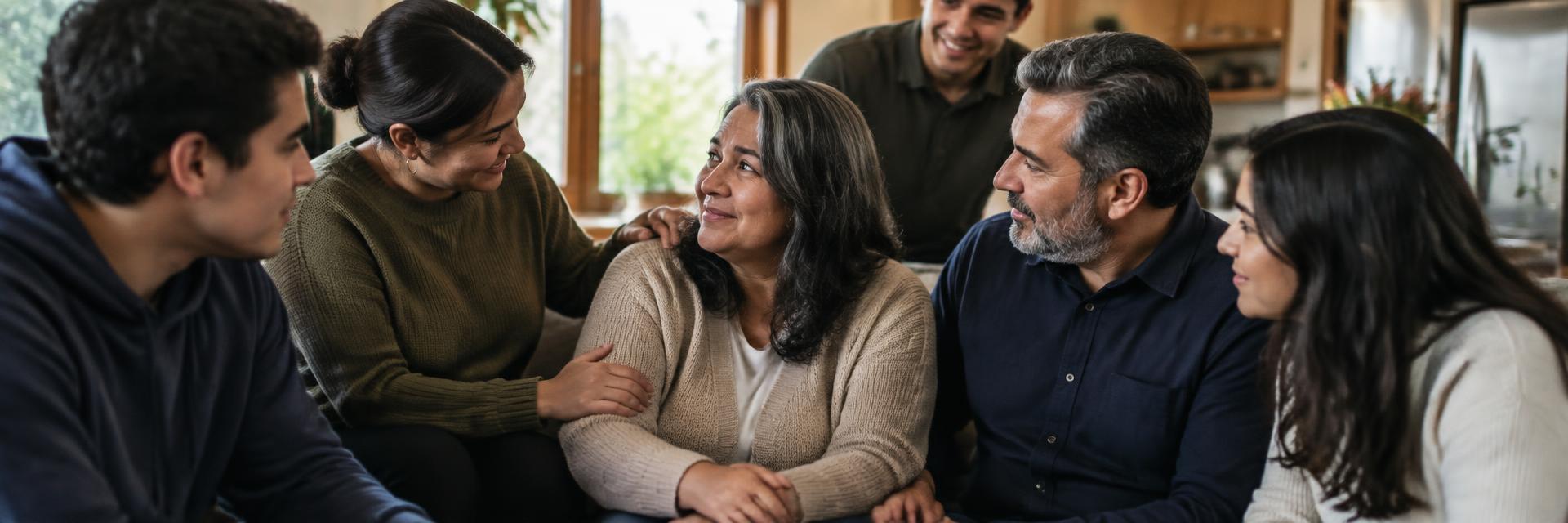
Sharing Parent Responsibilities and Leaning on Your Support System
Leaning on your support system
Most parents find it is best to tell close relatives and friends the truth about their child's illness. If you do not tell the truth, you will have to maintain a lie for many months. It might also hurt their feelings if you deny them the opportunity to help and support you. The support of your relatives and friends will be invaluable, and it will also be a relief to talk to them. Lean on relationships that are supportive.
Practical ways parents [caregivers] can cope
- This new journey will put strain on your marriage and/or partnership due to stress, fatigue, and emotions. Work together as a couple and share the burden on a practical level but also emotionally. You need one another and your child needs both of you.
- It is important that both parents fully understand all the implications of their child's disease and its treatment. Try to attend important discussions with the doctors together, if possible.
- Coordinating with extended family or friends for help and accepting offers of help with household tasks or the care of other children.
- Navigating insensitive comments or unsolicited advice takes skill and a tough skin. Do not allow people in your space that are negative or who don’t understand the reality of childhood cancer.
Balancing life as a parent of a sick child diagnosed with cancer
To balance the responsibility of your work and career with that of your sick child can be a major stressor. You may need to take unpaid leave at work when your regular leave is used up by long periods of hospitalisation. Loss of income could have a negative effect on the family. Be honest about your situation to people who would like to help and accept help if it is offered.
Practical ways parents [caregivers] can cope
- Negotiating time off, flexible work hours or working from home with employers.
- It is normal to have feelings of fear of losing your job. Speak to your employer and negotiate, if possible, time off to free you from the guilt, fear and/or the feeling of “split in two” between work obligations and hospital life.
- You might have to change your life plans, re-evaluate your goals and dreams, deal with a loss of control and learn to cope with many unknowns. You don’t need to journey alone; speak to a psychologist, social worker or a parent who has been there.
Research papers
- Yan Liu, et.al. 2025. Financial toxicity in pediatric cancer: lived experiences and coping strategies of parents. BMC Health Services Research. https://pmc.ncbi.nlm.nih.gov/articles/PMC12699799/
- Sheila Judge Santcroce, et.al. 2025. Influence of pediatric cancer-related financial burden on parent distress and other stress-related symptoms. Pediatric Blood Cancer. https://pubmed.ncbi.nlm.nih.gov/3 1762180/
- Carolyn R. Bates, et.al. 2023. Barriers and facilitators of family rules and routines during pediatric cancer treatment. Journal of Pediatric Nursing. https://www.sciencedirect.com/science/article/pii/S0882596323001264?utm_source
- Erin M Rodriquez, et.al. 2011. Cancer-Related Sources of Stress for Children With Cancer and Their Parents. Journal of Pediatric Psychology. https://pmc.ncbi.nlm.nih.gov/articles/PMC3282279/
- Sofia K. Hjelmstedt, et.al. 2021. A Balancing Act: Working and Caring for a Child with Cancer. Journal of Child and Family Studies. https://link.springer.com/article/10.1007/s10826-021-01997-1
Was this article helpful?
Related Articles

Going home: coping with the transition between hospital and home